
The Future of eSIM: What's Coming in 2026 and Beyond
 Owen5 min read
On this page
In 1991, the first SIM card was the size of a credit card. By 2024, Qualcomm squeezed the same functionality into a microscopic partition of a phone's main processor. That 33-year compression from plastic card to invisible silicon tells you where connectivity is going: it's disappearing into the hardware itself.
eSIM was the midpoint, not the destination. Here's what comes next, and when.
iSIM: The SIM Disappears Into the Processor
If you understand how eSIM works, you know there's a dedicated chip (the eUICC) soldered onto your phone's motherboard. It's small, about 5mm by 5mm. iSIM takes the next logical step: integrating that SIM functionality directly into the device's main processor.
No separate chip. No extra component. The SIM becomes a secure partition inside the same silicon that runs your apps.
Qualcomm shipped the first GSMA-certified iSIM in its Snapdragon 8 Gen 2 processor back in 2023, working with Thales on the security certification. Samsung has discussed integrating similar functionality into its Exynos line, though it hasn't shipped yet. The practical benefits are real but unglamorous: 98% smaller footprint, less power draw, one fewer component for manufacturers to source and solder. For phones, that saved space translates to slightly bigger batteries. The iPhone 17 Pro Max gained 265 mAh of battery capacity just by removing the physical SIM tray in eSIM-only markets.
But iSIM's bigger impact is in devices that aren't phones.
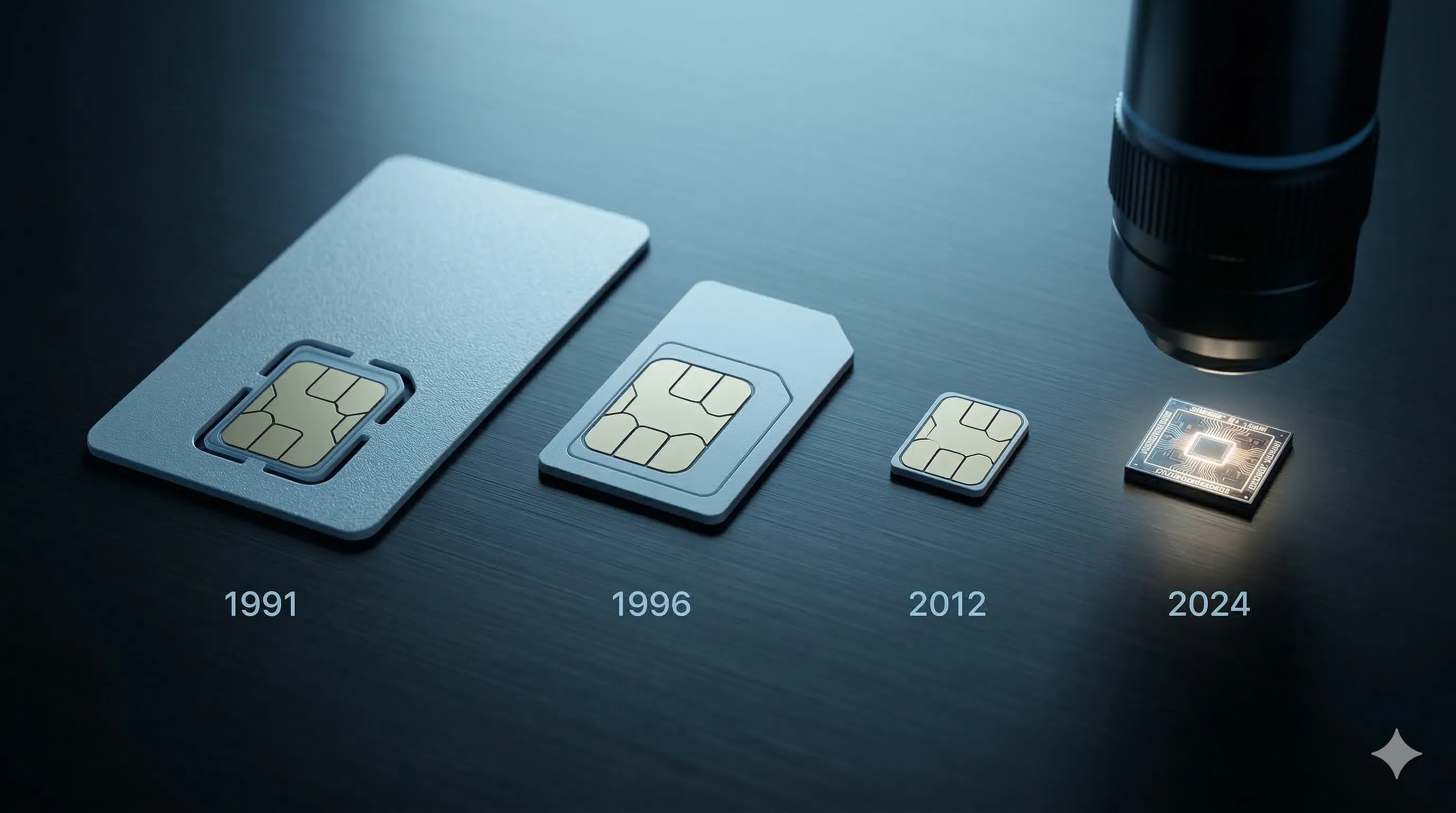
From a fingernail-sized card to a microscopic section of a processor. Each generation frees up space and power for the device itself.
Beyond Phones: Where eSIM Is Spreading
Wearables That Don't Need Your Phone
The Apple Watch and Samsung Galaxy Watch already support eSIM, but they still lean on a paired phone for most tasks. That's changing. As of 2026, smartwatches with independent eSIM connections can stream music, take calls, get directions, and send messages without a phone nearby. Garmin and other fitness brands are adding cellular to GPS watches for safety features like live location sharing and emergency SOS.
The wearable segment is growing faster than any other eSIM category. The reason is straightforward: people want to leave their phone behind sometimes. A run, a swim, a quick errand. An eSIM-connected watch makes that possible without losing your safety net.
Laptops With Built-In Cellular
A growing share of laptops now ship with eSIM support, and the number keeps climbing. Microsoft's Surface line, Lenovo ThinkPads, and HP EliteBooks already offer cellular connectivity. Apple is reportedly planning to add cellular to the MacBook Pro later in 2026, using its in-house C2 modem.
For business travelers, this matters more than any spec sheet improvement. WiFi in airports, hotels, and conference centers is unreliable. A laptop with its own eSIM connection means you stop depending on it entirely.
Connected Cars
Most new vehicles in North America now ship with embedded eSIM for telematics, navigation updates, and in-car WiFi. BMW, Mercedes, Tesla, and GM use eSIM to push over-the-air software updates, monitor vehicle health remotely, and provide passengers with a hotspot that works at highway speeds.
Your car's cellular connection is quietly becoming as standard as its Bluetooth.
IoT at Scale
Here's where iSIM really earns its keep. A shipping container sensor doesn't have room for an eSIM chip, much less a SIM tray. Smart meters, agricultural monitors, industrial trackers, asset tags. These are devices measured in millimeters, running on batteries that need to last years.
The GSMA's SGP.32 specification, released in 2023 and now entering mass deployment, was built specifically for this. Unlike the consumer eSIM standard (SGP.22), SGP.32 allows remote profile management on devices with no screen, no user interface, and minimal power. A platform called an eSIM IoT Remote Manager can push, swap, or deactivate profiles across thousands of devices without anyone touching them.
Most of those future iSIM devices won't be phones. They'll be things you never think about as "connected."
Carrier Adoption: The Tipping Point Is Here
Two years ago, eSIM support from carriers was patchy. You'd buy an eSIM plan and discover your destination's carriers didn't support activation for foreign-purchased eSIMs. That friction is fading fast.
More than two-thirds of mobile operators worldwide now offer eSIM connectivity for smartphones. More telling: carriers are starting to treat eSIM as the default activation method for flagship devices, not an alternative.
The biggest remaining holdout was China. That changed in late 2025 when the Ministry of Industry and Information Technology approved nationwide commercial eSIM trials, and all three major carriers launched services. China Unicom has committed to releasing at least one new eSIM-compatible phone model per month throughout 2026. The Asia-Pacific region now leads eSIM growth globally.
ABI Research projects eSIM-enabled device shipments will exceed 633 million in 2026. The eSIM market is growing fast, with shipments accelerating as more carriers and device makers commit to the standard.
The Physical SIM Timeline
So when does the plastic card actually go away?
Apple is the clearest signal. The iPhone 14 went eSIM-only in the US in 2022. The iPhone 17 expanded that to 12 countries in 2025 (Canada, Japan, UAE, and others). Multiple reports suggest the iPhone 18 will drop the SIM tray in Europe too.
Android manufacturers are a generation behind Apple but moving in the same direction. Samsung's Galaxy S25 Ultra still has a SIM tray worldwide, but the expectation is that flagship Android phones will start going eSIM-only in select markets by 2027.
Physical SIMs won't vanish overnight. Budget phones, emerging markets, and regions with less carrier support will keep them for years. But for anyone buying a flagship phone in 2026, the shift is unmistakable.

eSIM is expanding beyond phones to laptops, watches, and connected cars — the transition is gradual but accelerating.
What This Means for Travelers
If you already use eSIM for travel, the near-term future is just "more of the same, but smoother." More carriers support it. More countries have coverage. Activation keeps getting faster. For the basics on what eSIM is and whether your device supports it, we have guides that cover the current state.
The medium-term changes are more interesting:
Multi-device roaming. Your phone, watch, and laptop all on the same travel data plan, managed from one account. Some providers already offer this. It'll become standard.
Instant switching at borders. Instead of manually toggling profiles when you cross from France to Germany, your device negotiates the best local network automatically. The GSMA is working on specifications for this, and eSIM security improvements make it feasible without compromising subscriber protection.
No more QR codes. Apple's eSIM Carrier Activation and Android's push provisioning are already reducing the steps. Eventually, buying an eSIM plan and having it activate on your device will feel like installing an app. One tap.
The Bottom Line
eSIM isn't a trend. It's an infrastructure shift. The SIM card went from the size of a credit card (1991) to a nano-SIM the size of a fingernail (2012) to an embedded chip (2016) to a section of a processor (2024). Each step made connectivity cheaper, smaller, and more accessible to more types of devices.
By 2030, billions of devices will be connected through embedded or integrated SIMs, most of them not phones. Your car, your watch, the sensor tracking your package across the Pacific.
For now, the practical takeaway is simpler: if you're still fumbling with physical SIM cards when you travel, you're using yesterday's technology. The setup takes two minutes, and it only gets easier from here.
Photos from Pexels (free license).
Find data for your next trip
Compare coverage, data and validity before choosing your eSIM.
Browse destinationsMore for your trip

Learn
eSIM Security: Is It Safer Than a Physical SIM?
How eSIM technology protects against SIM swapping, physical theft, and cloning — plus the risks that remain and what you can do about them.
Owen4 min read
Learn
eSIM vs Physical SIM: What's the Difference?
A side-by-side comparison of eSIM and traditional SIM cards covering size, switching, security, multi-profile support, environmental impact, and which option fits your use case.
Owen4 min read
Learn
How Does an eSIM Work? The Tech Behind It, Made Simple
How eSIM profiles get downloaded, activated, and managed over-the-air. Covers QR code provisioning, carrier profiles, and the servers that make it all work.
Owen5 min read